
Cutting COD Returns With Better Checkout Design
- Most COD returns are not fraud in the criminal sense. They are bad addresses, buyer's remorse and unreachable phone numbers, and all three are checkout problems.
- Cutting COD returns starts with address quality, then a confirmation step, then prepaid nudges. In that order.
- A simple risk score built from order value, pincode history and repeat-refusal flags does most of the work of an expensive fraud tool.
- Every friction you add to reduce COD returns costs you some genuine orders. The job is to measure that cost, not pretend it is zero.
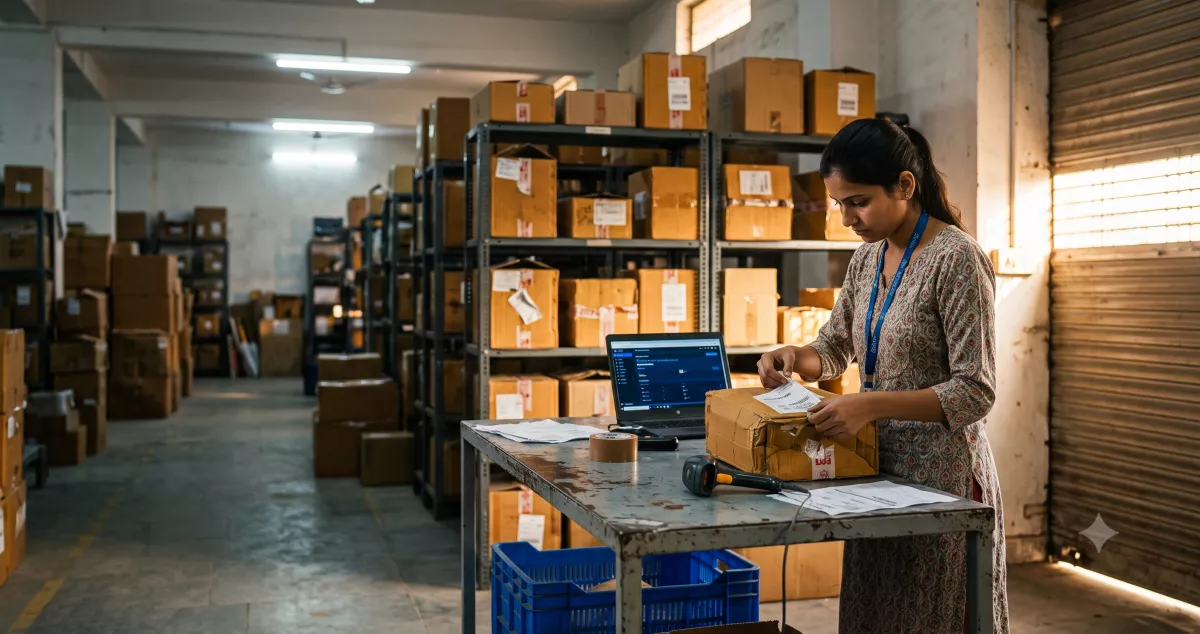
Kaya Naturals sells cold-pressed skincare out of a Jaipur warehouse. Say they ship 3,000 orders a month, 62% of them cash on delivery, and 19% of those come back as COD returns. That is roughly 350 boxes a month travelling to a doorstep and back, at forward and reverse freight both, with the product sometimes arriving crushed. Their founder called it a fraud problem. It mostly wasn't. When we pulled six months of courier remarks, the top three reasons were "address incomplete", "customer not reachable" and "customer refused, ordered by mistake". Nothing criminal. Just a checkout that let people place orders they could not receive. Which is why cutting COD returns is a design brief before it is a security brief.
What a refused parcel actually costs you
Owners underprice this constantly. They see the forward shipping charge on the invoice and stop there. COD returns bill you across four lines, quietly: forward freight, reverse freight, the packaging you cannot reuse, and the working capital sitting inside a box that spent nine days in a van. For a mid-priced D2C order in India, the fully loaded cost of one refused COD parcel typically lands somewhere between two and four times the forward shipping charge. On Kaya's illustrative numbers, 350 refusals a month is not a rounding error. It is a headcount.
There is a second cost that never shows on a P&L. Courier partners rate sellers on delivery success. A rising refusal rate quietly gets you slower pickups and worse rate cards at renewal. So cutting COD returns is partly a negotiation strategy.
Address quality is the biggest single win against COD returns
Indian addresses are not a single line of structured data. They are landmarks, floor numbers, gate colours and a pincode that people frequently get wrong by one digit. A checkout that accepts anything typed into a textarea will happily accept an address that no delivery executive can find.
Four changes carry almost all of the improvement here.
Kaya shipped the pincode-first pattern and the split fields in one sprint. Address-failure refusals fell noticeably within a month, and the customer care team stopped spending its mornings calling people to reconstruct flat numbers. Same order volume. Far fewer COD returns coming home.
The confirmation step nobody wants to build
Here is the part founders resist. After a COD order is placed, before it is packed, you send one message asking the buyer to confirm. A WhatsApp message with two buttons works better than an SMS with a link, and both work better than a phone call your team will not make consistently.
The objection is always the same: won't people cancel? Yes. Some will. That is the feature. A cancellation before packing costs you nothing but a picking slip. The same cancellation at the doorstep costs you the full stack from the previous section. You are not losing revenue at the confirmation step. You are discovering revenue you never had, earlier and more cheaply.
Two details decide whether this works. First, the message must come from a number the buyer recognises as your brand, ideally the same one your order updates use. Second, confirmation must be one tap. If the buyer has to type "yes" or open a page and log in, your confirmation rate collapses and you end up cancelling good orders.
Prepaid nudges that do not feel like a punishment
The cheapest COD order is the one that becomes a prepaid order. But most stores go about this badly, either by hiding COD behind a wall of warnings or by slapping on a fee that reads as a fine. Both damage conversion on the exact customers you want.
- A small prepaid discount shown as a saving on the payment step, not buried in a coupon field
- Free shipping on prepaid while COD carries the actual handling charge, stated plainly
- Faster dispatch promised, and then actually delivered, for prepaid orders
- UPI shown first with the buyer's likely app, since one tap beats card entry every time
- A COD fee introduced silently at the last step, which reads as a bait and switch
- Removing COD entirely in tier 2 and tier 3 cities where trust is still being earned
- Warning copy about fake orders, which insults the 90% who are honest
- A partial-payment scheme so complicated that support has to explain it
A useful middle path is a token prepayment. Ask for a small non-refundable amount up front, say the shipping charge, with the balance collected on delivery. It converts far better than full prepaid on a high-ticket order and it materially changes refusal behaviour, because a buyer with money already in the order shows up. Treat it as an option, never the default.
Risk scoring without a data science team
You do not need a machine learning model to cut COD returns. You need four columns in a spreadsheet and a rule that fires at checkout. Score each order and route it down one of three paths.
| Signal | Low risk | Medium risk | High risk |
|---|---|---|---|
| Order value | Below your average | Around 2x average | Well above average |
| Buyer history | Delivered before | First order | Prior refusal on this phone or address |
| Pincode record | Strong delivery rate | Mixed | Repeatedly poor |
| Address completeness | Landmark and flat number present | One field thin | Vague, single line |
| Action | Ship as normal | WhatsApp confirmation | Prepaid only, or token payment |
Run this as a manual review for two weeks before you automate it. You will find your own patterns, and they will not match anyone else's. Kaya discovered that their worst refusal cluster was not a city at all, it was a specific bundle offer that attracted impulse orders. They changed the offer. The cluster went away, no fraud tooling involved.
What does not work on COD returns
An honest note, because COD returns work gets sold with a lot of confidence it has not earned.
- Blacklisting phone numbers alone. Numbers are cheap. Address plus number plus device gives you a far better fingerprint, and even that is defeated easily by anyone determined.
- Third-party fraud scores as a first purchase. They are useful once your volume is high enough that manual review is impossible. Below that, you are paying a monthly fee for rules you could have written.
- Removing COD to "solve" the problem. In most Indian categories COD is still where a large share of first purchases live. Killing it usually costs more revenue than the refusals did.
- Adding every check at once. If you launch address validation, OTP, confirmation and a COD fee in the same week, you will never know which one moved the number, and you will not be able to roll back the one that hurt.
There is a real trade-off here and you should name it out loud. Every verification step removes some genuine buyers who were in a hurry, were on a bad connection, or simply did not want another OTP. In our experience that leak is small next to the refusal savings, but it is never zero, and any agency telling you otherwise has not measured it.
A thirty-day rollout plan
Do it in this sequence, one change per week, measuring refusal rate and checkout completion side by side.
Week one: baseline export and reason bucketing. Nothing ships. Week two: pincode-first address form with split fields and a required landmark for new buyers. Week three: WhatsApp confirmation on medium-risk orders, with a twenty-four hour window. Week four: prepaid incentive on the payment step plus the token-payment option for high-value COD.
Watch two numbers together, always. COD returns should fall. Checkout completion should stay flat or dip by a point at most. If completion drops harder than that, the friction landed in the wrong place, and the fix is usually to narrow which orders the check applies to rather than to remove it.
- Bucket your COD returns by courier reason before changing anything.
- Fix the address form first. It is the cheapest and largest improvement available.
- Confirm medium-risk orders on WhatsApp with one-tap buttons and a generous window.
- Make prepaid attractive rather than making COD painful.
- Score risk with four simple signals and review manually before automating.
Refused parcels feel like something happening to you. They are mostly something your checkout is doing, and that means you can fix them with design decisions rather than with suspicion. Start with the address form, add confirmation where the risk sits, and let prepaid win on merit. Done in that order, cutting COD returns pays for itself well before the quarter ends, and your courier rate card gets better as a bonus.
DL Minds Team
Digital marketing and web development expert at DL Minds. Passionate about helping businesses grow through innovative technology solutions and strategic digital marketing.